





YouTube Music, The Technology That Built It
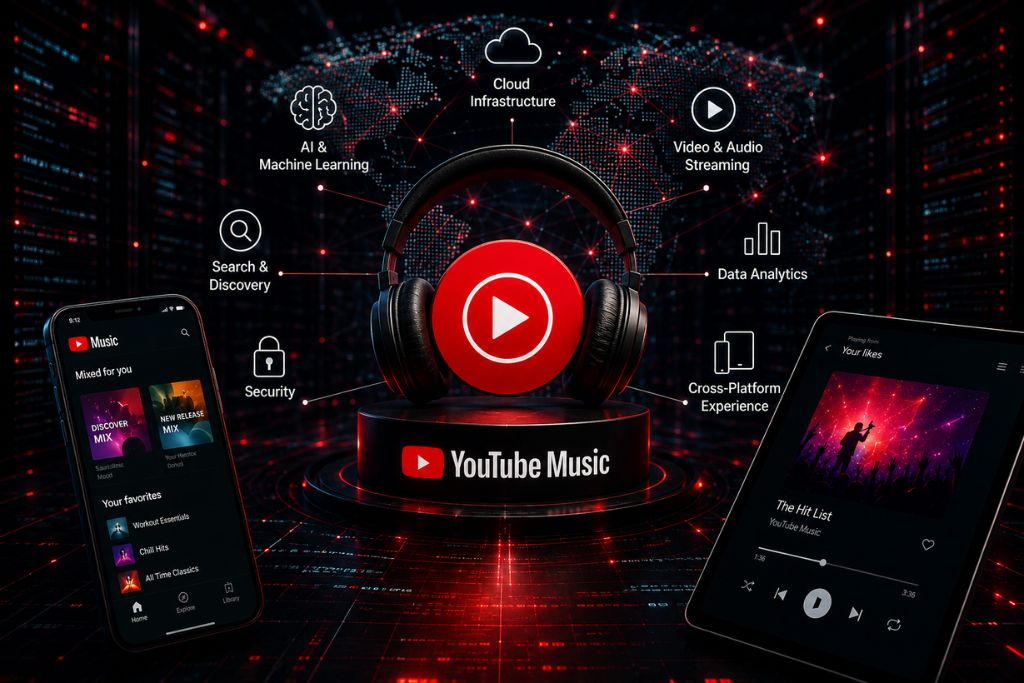
The music streaming industry has changed how people discover, consume, and share audio content. Among the biggest players in this space is YouTube’s music platform, YouTube Music. What makes the platform remarkable is not just its massive music catalog, but the technology infrastructure quietly operating behind every recommendation, playlist, livestream, and search query.
From artificial intelligence to cloud computing and distributed systems, YouTube Music represents one of the most advanced streaming ecosystems ever built.
What Is YouTube Music?
YouTube Music is a music streaming platform developed by Google under the broader YouTube ecosystem. Officially launched in 2015 and later redesigned in 2018, the service combines traditional music streaming with YouTube’s enormous video infrastructure.
Unlike many competitors, YouTube Music benefits from direct integration with music videos, user-generated content, live performances, remixes, and podcasts. This hybrid model required an entirely different technical architecture from conventional audio-only streaming platforms.
The result is a platform capable of serving billions of streams globally while delivering highly personalized user experiences in real time.
The Core Technologies Behind YouTube Music
1. Artificial Intelligence and Machine Learning
One of the biggest reasons users stay engaged on YouTube Music is its recommendation engine. The platform continuously analyzes listening behavior, search history, mood patterns, location trends, and engagement signals.
This recommendation system is heavily powered by machine learning models developed within Google’s AI ecosystem.
The platform uses AI for:
- Personalized playlists
- Music discovery
- Voice search optimization
- Context-aware recommendations
- Auto-generated mixes
- Content moderation
- Audio classification
YouTube Music’s recommendation engine is particularly effective because it inherits years of user behavior data from the larger YouTube platform.
2. Cloud Infrastructure
The platform runs on Google Cloud infrastructure, which allows it to scale globally with low latency.
Every second, millions of users simultaneously:
- Stream songs
- Upload content
- Search tracks
- Watch music videos
- Interact with playlists
Managing this level of traffic requires distributed cloud systems capable of automatic scaling and high availability.
Google’s global server network helps YouTube Music reduce buffering and improve playback speeds across different regions.
Programming Languages That Built YouTube Music
Behind the sleek interface lies a complex stack of programming languages working together across frontend systems, backend services, data engineering pipelines, and AI infrastructure.
Python
Artificial Intelligence systems within YouTube Music heavily rely on Python.
Python is widely used for:
- Machine learning models
- Recommendation systems
- Data analysis
- AI experimentation
- Backend automation
Libraries such as TensorFlow, developed by Google itself, play a huge role in powering music recommendations and predictive analytics.
C++
C++ is deeply embedded in YouTube’s performance-critical systems.
It is commonly used for:
- Video processing
- Audio encoding
- Streaming optimization
- Low-level infrastructure
- Performance-intensive backend services
Because streaming platforms process enormous multimedia workloads, C++ helps maintain speed and efficiency.
Java
Java powers many enterprise-scale backend systems across Google’s infrastructure.
YouTube Music uses Java-related technologies for:
- Scalable backend architecture
- Distributed systems
- API services
- Server-side processing
Java remains valuable because of its reliability and ability to handle large-scale concurrent requests.
JavaScript and TypeScript
The frontend experience of YouTube Music relies heavily on JavaScript technologies.
These languages help power:
- Interactive interfaces
- Dynamic playlists
- Real-time UI updates
- Web playback controls
- Responsive design
Modern frontend frameworks and TypeScript improve maintainability and scalability across massive codebases.
Go (Golang)
Google also created Go, and it has become increasingly important in cloud-native services.
Go is known for:
- High concurrency
- Efficient networking
- Fast backend services
- Microservice architecture
Its lightweight performance makes it ideal for streaming infrastructure.
The Role of Big Data
Every interaction on YouTube Music generates valuable data.
The platform processes:
- Listening duration
- Skipped tracks
- Repeat behavior
- Search queries
- Device types
- Geographical listening patterns
This massive flow of information is analyzed in real time using big data technologies.
These analytics help:
- Improve recommendations
- Detect trending songs
- Optimize streaming quality
- Personalize user experiences
- Reduce churn
Without big data engineering, modern streaming platforms would struggle to maintain user engagement.
Audio and Video Streaming Technology
Unlike traditional music platforms, YouTube Music must support both audio and video streaming simultaneously.
This requires advanced:
- Adaptive bitrate streaming
- Compression algorithms
- CDN optimization
- Video transcoding systems
- Real-time synchronization
Adaptive streaming ensures users can continue listening even under fluctuating network conditions.
This is one of the most technically demanding aspects of the platform.
You might also be interested in: Gemini, The Technology That Built It
Search Technology and Metadata Systems
Search is one of YouTube Music’s strongest capabilities.
The platform leverages Google’s search technologies to understand:
- Song titles
- Lyrics
- Artist names
- User intent
- Misspelled queries
- Voice commands
Its metadata systems also organize enormous amounts of music information across millions of tracks and videos.
Security and Content Management
A platform operating at YouTube’s scale must also address copyright protection and content moderation.
Technologies used include:
- AI-based copyright detection
- Automated content scanning
- Digital fingerprinting
- Fraud prevention systems
- Encryption protocols
These systems help protect artists, labels, and users while maintaining platform integrity.
Mobile Technology and Cross-Platform Engineering
YouTube Music supports:
- Android
- iOS
- Smart TVs
- Web browsers
- Smart speakers
- Wearable devices
Cross-platform development requires robust API architectures and synchronized cloud services.
This ensures users can seamlessly continue listening across multiple devices.
Why YouTube Music’s Technology Matters
What makes YouTube Music technologically unique is its fusion of:
- AI-driven personalization
- Video streaming infrastructure
- Search engine intelligence
- Global cloud computing
- Big data analytics
Very few companies possess the engineering scale required to combine all these technologies into one ecosystem.
The platform is not merely a music app. It is a highly sophisticated technology product built on decades of infrastructure innovation from Google and YouTube.
Final Thoughts
YouTube Music demonstrates how modern streaming platforms are powered by far more than media libraries. Behind every playlist recommendation and instant search result is a massive network of algorithms, servers, programming languages, and cloud systems operating in real time.
From Python-driven AI models to C++ streaming engines and Go-powered infrastructure, the platform reflects the future of scalable digital entertainment.
As streaming continues to evolve, technologies like machine learning, distributed computing, and intelligent recommendation systems will only become more central to how users experience music globally.
